By Olympic Equipment
Plan lift access, oil collection equipment, storage, service carts and used-oil handling as one practical maintenance-bay workflow.
Plan the complete job route
A routine-maintenance bay works best when equipment choices follow the work. The lift, collection equipment, carts, parts and storage all need a place in the plan. Buying an oil drain after the lift is installed may reveal an awkward reach or a route that crosses the technician’s normal work area.
Begin with a service menu and vehicle list. Explain which jobs the bay will handle, which jobs belong elsewhere and the largest or most difficult vehicles expected. This guide addresses planning the workspace and equipment; it does not provide a vehicle lifting or oil-changing procedure.
Match collection equipment to the working space
Ask the supplier to confirm the selected drain’s operating-height range, collection arrangement, capacity and intended fluids. Compare those details with the proposed lift and vehicle access. A large tank alone does not establish that the bowl, base and adjustment mechanism work in the planned bay.
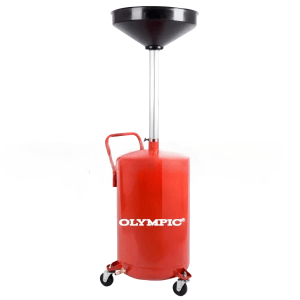
Olympic’s collection includes several oil-drain designs. Confirm the exact model and instructions rather than treating portable, pressurized and non-pressurized equipment as interchangeable. Have the supplier explain the permitted transfer arrangement and any required utilities. Do not improvise pressure, fittings or discharge equipment.
Draw the bay with equipment in use
On a simple plan, mark the lift, doors, fixed equipment, cart storage and the route to the used-oil holding area. Include the drain’s base and where it will be kept between jobs. Review the plan with the people who will actually use the bay, then ask the installer to evaluate the equipment layout.
Consider access to the vehicle without assuming that every lift style exposes the same areas. Tell the supplier what needs to be reached during your planned services. A drive-on runway, a frame-engaging arm and a scissor platform create different access questions, so the actual vehicle-and-lift combination needs review.
Keep collection and storage decisions separate
A mobile oil drain is one part of the handling system. Establish where collected oil goes next, how equipment is transferred under its instructions and who arranges collection by the appropriate service provider. Avoid leaving the final storage decision until a portable tank is already full.
EPA’s business guidance calls for suitable used-oil containers in good condition, clear ‘Used Oil’ labeling and steps to prevent and address leaks or spills. It also warns against mixing used oil with other substances. Consult the applicable state program and your waste-service provider for the requirements at your location.
Give supplies and records a home
Plan separate locations for new fluids, filters, collection supplies and spill-response materials. Establish who checks inventory and equipment condition. A cart should have a defined parking place so it does not become an obstruction when the bay changes from one vehicle to the next.
Keep the selected equipment instructions and service records accessible. Label an equipment record with the actual model rather than a general term such as ‘red oil drain.’ When a device is replaced, revisit the layout and handling plan instead of assuming the new item has the same limits or transfer method.
Compare the usable bay, not just the bundle
Ask a proposal to identify each included item and the installation, utility and training scope. Confirm what is still needed to provide the planned services. A package description may simplify purchasing, but it does not replace checking access, equipment coverage and the used-oil handling arrangement.
Olympic can help identify lift and accessory candidates, while qualified professionals and the appropriate environmental resources resolve the site-specific questions. A complete maintenance-bay plan connects vehicle access, collection, movement, storage and responsible handling. That makes the equipment selection more useful than choosing separate items by capacity alone.
Sources and related resources
EPA: Used-oil information for businesses
Continue reading in the Motorcar lift guide library or browse the Olympic lift video library.
Published by Olympic Equipment, a seller of vehicle lifts and shop equipment with a commercial interest in equipment purchases. Prepared with AI assistance; no independent technical review is represented. This educational planning guide does not replace current manufacturer instructions, qualified training or a site-specific professional assessment. First published on Motorcar Magazine. Sources checked October 26, 2026.


