ELECTRIC RECORD / 1899
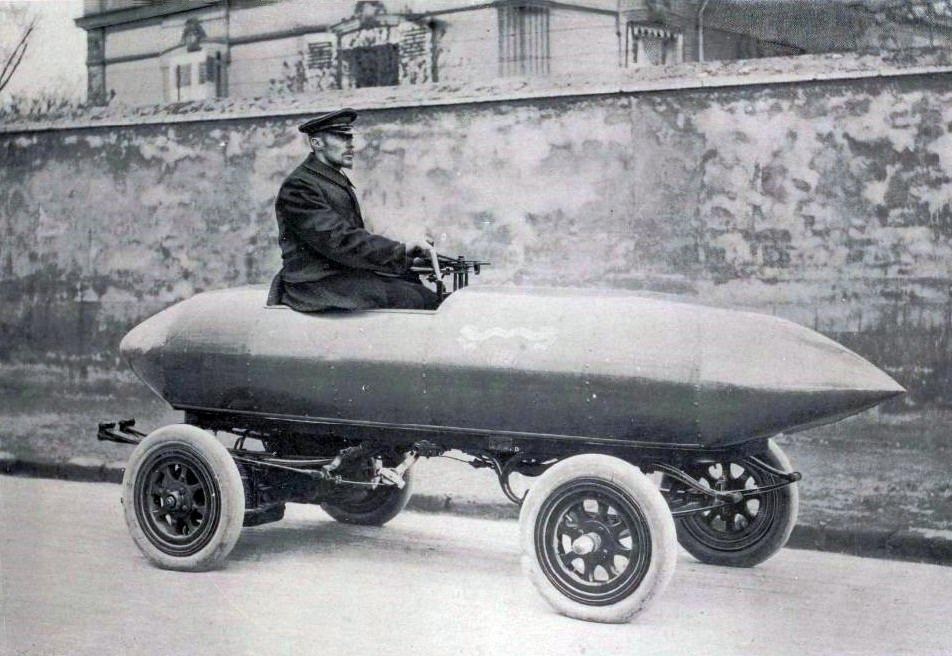
The first road vehicle to pass 100 km/h did not burn petrol. On April 29, 1899, at Achères near Paris, Belgian engineer Camille Jenatzy drove his electric La Jamais Contente to 105.88 km/h, about 65.8 mph.
A record war between electric cars
The first recognized land speed record was set at Achères on December 18, 1898, when Count Gaston de Chasseloup-Laubat drove a Jeantaud electric car over a flying kilometre at 63.15 km/h. Jenatzy, nicknamed “Le Diable Rouge,” the Red Devil, for his red beard, beat it on January 17, 1899, with 66.66 km/h. The count answered the same day, and the two kept trading the mark until Chasseloup-Laubat reached 92.78 km/h on March 4.
Jenatzy had commercial reasons to care. He ran a business building electric carriages and trucks for the Paris market and competed hard with the carriage-maker Jeantaud in publicity stunts over whose vehicles were fastest.
The “Never Satisfied”
Jenatzy’s answer was a purpose-built car, generally cited as the first designed specifically to set a land speed record. Its torpedo-shaped body was made of partinium, a light alloy. Two electric motors, each driving the rear axle through a chain, produced roughly 68 hp combined, and the car ran on Michelin tires.
The aerodynamics were only half solved. Jenatzy sat high above the body and the chassis was exposed underneath, as the period photographs make plain. Even so, it was enough: the run carried a road vehicle past 100 km/h for the first time.
A note on the date: some references give May 1, 1899. We use April 29, the date in La Vie au Grand Air’s report two weeks after the run and in standard land speed record lists.
Electric, then steam, then petrol
Jenatzy’s record stood until April 1902, when Léon Serpollet’s steam car went faster at Nice. Petrol engines soon took over both the record books and the market. That makes La Jamais Contente a useful reminder that early motoring was a three-way contest; our story on Fred Marriott’s 1906 Stanley steam record picks up the steam chapter.
The original car survives at the National Car and Tourism Museum in the Château de Compiègne, France.
Video credits: Narration generated with an AI voice (ElevenLabs) from a script based on published land speed record histories. Images via Wikimedia Commons: period photographs and illustrations from La Vie au Grand Air, Jules Beau, Max de Nansouty, Agence Rol, Agence Meurisse and L’Almanach des Sports 1899 (public domain); Compiègne museum photo by Van Der Meulen Christofle (CC0).