SWEDISH SAFETY / 1959
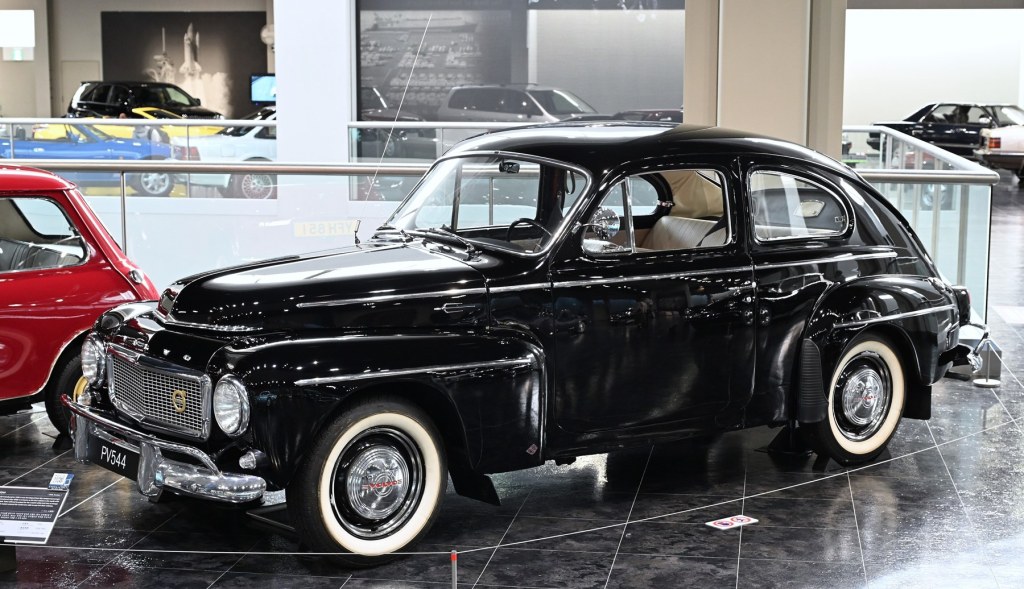
On August 13, 1959, according to Volvo, a PV544 was delivered to a dealer in Kristianstad, Sweden, as the world’s first car with three-point safety belts fitted as standard. The design by engineer Nils Bohlin is still the basic layout of the belt you fasten today.
Belts already existed
Seat belts were not new in 1959. Nash offered them as a factory option on its 1949 models and Ford on its 1956 models, and Saab made belts standard in 1958. Three-point layouts had been patented too. Volvo itself had introduced a two-point diagonal belt in 1957, but Bohlin later wrote that its own accident investigations showed that belt was “not good enough,” particularly when doors opened and occupants were ejected.
Bohlin’s V
Bohlin came to Volvo in 1958 from Saab, where he had worked on aircraft ejection seats. In a statement quoted by Volvo, he explained the idea: “both the upper and lower body must be held securely in place with one strap across the chest and one across the hips,” with an immovable anchorage low beside the hip, in a belt that “could be put on conveniently with one hand.”
Volvo’s 50th-anniversary release lists the essentials: a lap belt plus a diagonal body belt, a low anchorage beside the seat, a V-shaped geometry pointing to the floor, and a belt that stays in place under load. In the Nordic market the PV544 and Amazon (120) were first to carry it.
An open patent
Bohlin’s U.S. patent, number 3,043,625, was filed in August 1959 and issued in 1962. Volvo describes it as an open patent: other manufacturers were allowed to use the design free of charge. Accounts differ on exactly when that policy was formalized, but the result is not in dispute; the three-point belt spread across the industry and into law.
Bohlin backed the design with data, presenting a study of 28,000 accidents in Sweden in which no belted occupant was fatally injured at accident speeds below 60 mph. Volvo now credits the three-point belt with saving more than one million lives.
Video credits: Narration generated with an AI voice (ElevenLabs) from a script based on Volvo’s published history and the sources above. Images via Wikimedia Commons: 1959 Volvo PV544 photos by TTTNIS (CC0); Volvo Amazon by AlfvanBeem (CC0); PV544 interior by Niels de Wit (CC BY 2.0); belt-fastening photo by State Farm (CC BY 2.0); crash-test dummy by ITU Pictures (CC BY 2.0); belt buckle by Santeri Viinamäki (CC BY-SA 4.0); PV544 rear view by Palauenc05 (CC BY-SA 4.0). Patent drawing from US Patent 3,043,625 (public domain).