Published by Olympic Equipment
In the spring of 1903, a Vermont doctor bet $50 that an automobile could be driven from San Francisco to New York. There were almost no paved roads between the two cities, no road maps made for motorists and no gas stations. Sixty-three days later he had done it.
A bet made without a car
Horatio Nelson Jackson was 31 and visiting San Francisco when the argument started at the University Club. Most people in the room thought the automobile was a rich man’s toy that would never replace the horse. Jackson took the other side and accepted the wager. He did not own a car, and he had very little driving experience.
Within days he bought a used 20-horsepower Winton touring car, named it the Vermont after his home state, and hired Sewall K. Crocker, a young mechanic and former bicycle racer, to share the driving and keep the car running. They left San Francisco on May 23, 1903.
A country without roads
The pair went north through Oregon and Idaho to avoid the worst of the mountains and the desert. Much of the route was wagon trail, riverbank or open country. They carried a block and tackle and used it again and again to drag the Winton out of mud and across streams.
Breakdowns set the schedule. When a part failed, they waited days for a replacement to arrive by train or stagecoach, or found a blacksmith who could make something that would do. Tires wore out faster than they could be replaced. Every repair was done lying in the dirt beside the trail.
In Idaho they added a third traveler: a bulldog named Bud. The dust bothered his eyes, so Jackson fitted him with a pair of driving goggles. Newspapers along the route loved him, and crowds began to gather when the Vermont came into town.
Sixty-three days
Jackson, Crocker and Bud reached New York City on July 26, 1903. It is recognized as the first crossing of the United States by automobile. Two other teams, one in a Packard and one in an Oldsmobile, finished their own crossings later that summer.
The trip cost Jackson about $8,000, including the car. By most accounts he never collected the $50.
He later gave the Winton to the Smithsonian Institution. It is in the collection of the National Museum of American History, displayed with a figure of Bud in his goggles.
What it has to do with your garage
Read the accounts of the trip and one detail keeps coming back: getting underneath the car was the hard part of almost every repair. Jackson and Crocker had a jack, some hand tools and whatever flat ground they could find.
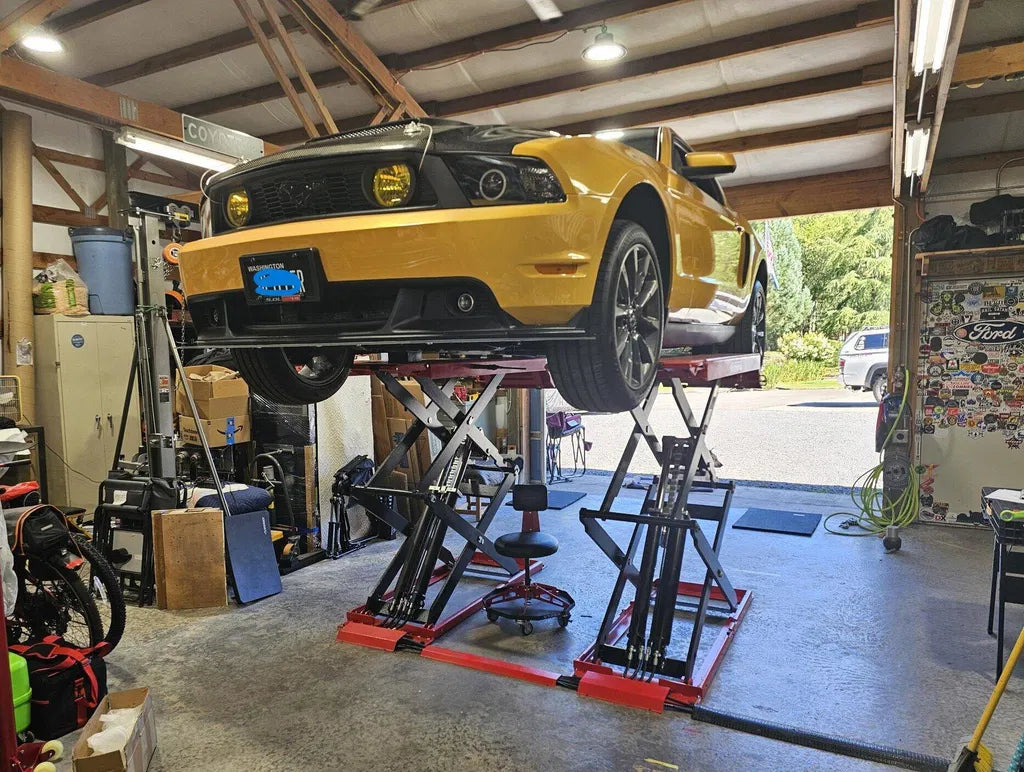
Cars have changed completely since 1903. The job of looking after one has changed less than you might think. Good light, room to work and a safe way to get under the vehicle still separate a repair you dread from one you can do well. If you are planning that kind of space for a car you care about, start with Planning Lift Storage for Classic Cars and 12 Reasons a Car Lift Makes Garage Life Easier.
Further reading: the Smithsonian National Museum of American History, which holds the Winton, and the PBS documentary Horatio’s Drive: America’s First Road Trip.
More from Olympic Equipment: shop auto lifts and shop equipment at olympic-equipment.com, watch our videos on YouTube, and follow us on Facebook.
Company disclosure: Olympic Equipment sells automotive lifts and shop equipment and has a commercial interest in equipment purchases. This article was prepared with AI assistance.