Published by Olympic Equipment
The vehicle that became the Jeep was designed in a matter of days, by a company that then lost the contract to build it. More than 600,000 were made during the Second World War, and the civilian versions that followed opened the market for the four-wheel-drive vehicles Americans drive today.
Forty-nine days
In the summer of 1940 the U.S. Army asked manufacturers for a light reconnaissance vehicle with four-wheel drive. The requirements were demanding and the deadline was worse: a working prototype in 49 days.
Only a few companies showed real interest. One was American Bantam, a small and nearly bankrupt carmaker in Butler, Pennsylvania. Bantam brought in a Detroit engineer named Karl Probst, who laid out the design in a few days of nearly nonstop work. Bantam’s hand-built prototype was driven to the Army’s test center at Camp Holabird, Maryland, and delivered on September 23, 1940, with very little time to spare.
Three companies, one design
The Army liked what it saw, but doubted that tiny Bantam could build vehicles in the numbers a war would require. It shared the design with two larger companies, Willys-Overland and Ford, and both produced their own prototypes.
The Willys version held the strongest card: a 60-horsepower four-cylinder engine nicknamed the Go Devil, well ahead of its rivals on power. The Army standardized on the Willys design, known as the MB. When demand outran what Willys could build, Ford produced a nearly identical vehicle called the GPW. Bantam built a few thousand early vehicles and spent most of the war making trailers.
Where the name came from
Nobody knows for certain. One explanation is that soldiers slurred the letters “GP” into a word. Another credits Eugene the Jeep, a small, resourceful creature from the Popeye comic strip. Both stories have their supporters, and the argument is unlikely to be settled.
Home from the war
Soldiers came home with strong opinions about the little vehicle that had gone everywhere. Willys moved fast. In 1945 it introduced the CJ-2A, the first Jeep sold to civilians, and marketed it to farmers and ranchers as a machine that could do the work of a truck and a tractor.
The CJ-2A added a tailgate, a side-mounted spare and larger headlights. It also carried the seven-slot grille that still identifies a Jeep.
The Jeep in your garage
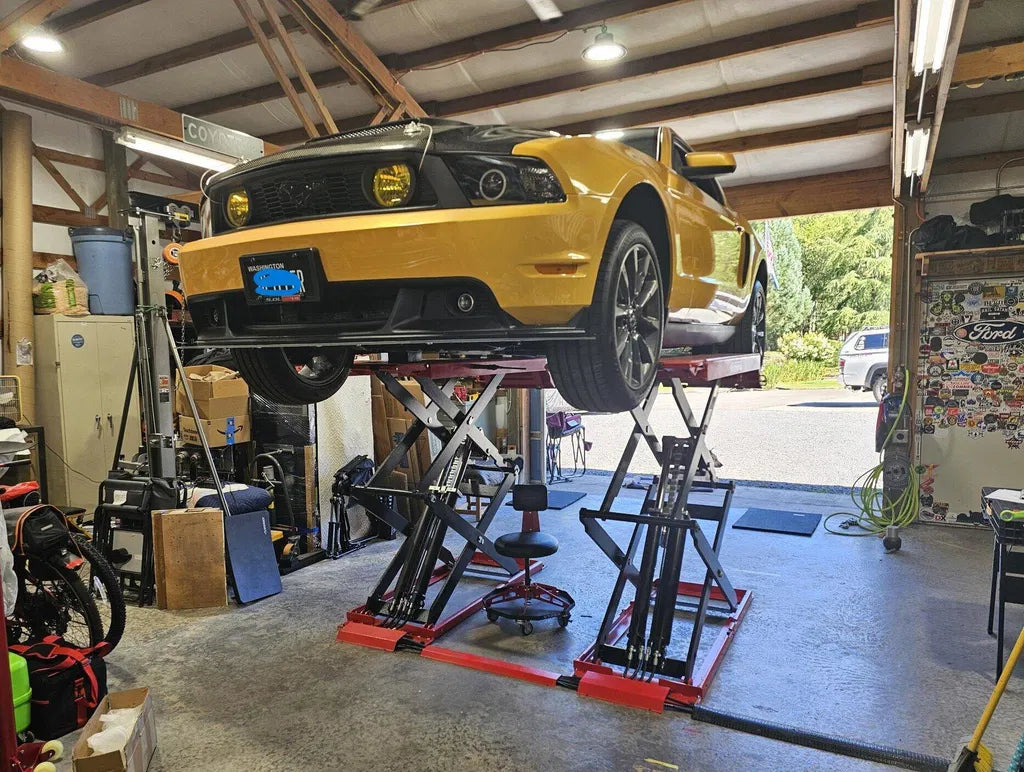
Few vehicles get modified as often as Jeeps. Lift kits, larger tires, heavier bumpers, winches and armor all change the weight, the height and the places where the vehicle can safely be supported. A Jeep that suited a garage and a lift when it was stock may not suit them the same way after the build.
If that sounds like your project, read Choosing Lifting Equipment for a Jeep With Oversized Tires and A Modified Vehicle Needs a Specific Lift Application Review before you buy equipment.
Further reading: the U.S. Army’s historical records on the quarter-ton truck program, Jeep’s own heritage timeline, and the historical accounts of American Bantam kept in Butler, Pennsylvania.
More from Olympic Equipment: shop auto lifts and shop equipment at olympic-equipment.com, watch our videos on YouTube, and follow us on Facebook.
Company disclosure: Olympic Equipment sells automotive lifts and shop equipment and has a commercial interest in equipment purchases. This article was prepared with AI assistance.