By Olympic Equipment
The words used to describe a lift often mix two different ideas: how the equipment raises a vehicle, and whether it is meant to stay in one place. “Scissor” describes a lifting mechanism. “Portable” describes whether a particular model is permitted to be moved or stored when it is not in use. Some scissor lifts are portable. A pair of portable frames is a different kind of equipment altogether. Neither label, on its own, tells you whether a given vehicle will fit or whether the work you have in mind can actually be done.
This guide gathers the questions that come up most often when shops and home garages compare scissor lifts with portable frame lifts, and when the same buyers start asking about detailing, body work, motorcycles, and ATVs or UTVs. It is planning guidance. The manual for the exact equipment, the vehicle manufacturer’s instructions, and a qualified review of the site still govern any purchase or installation.
Scissor lifts and portable frame lifts are not interchangeable descriptions
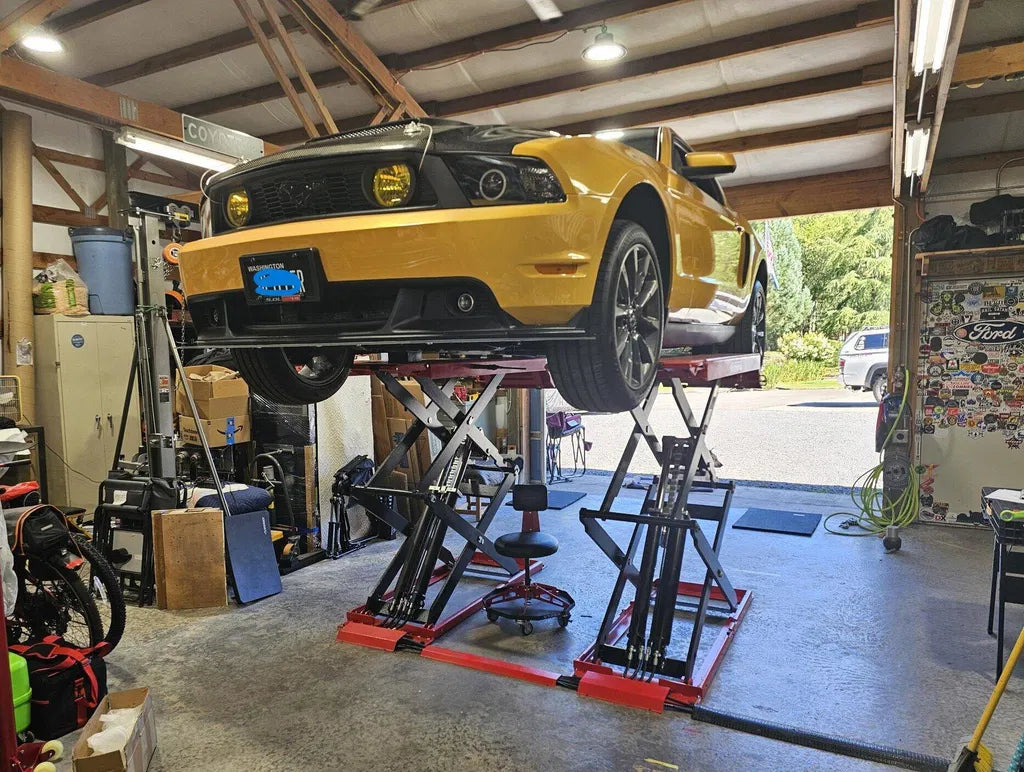
A scissor lift uses a scissor mechanism to raise a platform, pads, or a similar support arrangement. A portable frame lift is typically a pair of independent frames placed under the vehicle. Because the two designs support a vehicle in different places, they also leave different openings underneath it. A pair of frames may leave a more open path along the centerline than a platform-style scissor design; a scissor platform, arms, or crossmembers can sit directly under parts you hoped to reach.
Compare the actual equipment, not the category name. Look at support points, center access, operating height, collapsed height, and the installation or movement rules in the manual. Confirm when and how the equipment may be moved, if movement is even permitted. A vehicle does not “fit” because a brochure uses a familiar word.
Collapsed height is only one clearance number
Collapsed height is the lift’s height in its fully lowered position, as the manufacturer defines that position. It matters when you are trying to decide whether a vehicle can approach and clear the equipment at all. It is not a complete clearance answer.
Ramps, pads, extensions, the vehicle’s wheelbase, and the lowest parts of the body or exhaust all affect the approach. A car with enough advertised ground clearance can still hang up on a ramp angle, a raised pad, or a low exhaust section that is not above the lowest point you measured. Compare the dimension drawing with the actual vehicle and with any approved accessories you plan to use. Do not assume a lift is suitable simply because its advertised lowered height is less than the vehicle’s published ground clearance.
What a scissor structure can block
Platforms, arms, and crossmembers limit access to whatever sits directly above them. On some vehicles that may be a section of the exhaust, part of the transmission area, or another underbody component you expected to see clearly. An “open center” is useful when the opening actually lines up with the work, but it does not guarantee access for every repair.
Before you buy, put the lift drawing next to the components you expect to service and think about the room your tools need, not only whether you can see the part. Never shift the vehicle off its approved support points just to make a part easier to reach.
Exhaust work in particular
For an exhaust job, compare the vehicle’s exhaust route with the exact lift’s platforms, arms, crossmembers, and open areas. Seeing the pipe is not the same as having room for tools or for any support equipment the vehicle or exhaust manufacturer requires. Use the dimension drawings and the vehicle’s service information to plan the work.
Do not remove lift components or relocate contact points to gain access. If the approved setup obstructs the repair, the answer is a different suitable lifting arrangement, not a workaround. Send Olympic the lift model and the vehicle details before you commit to equipment for a specific exhaust job.
Surface-mounted or recessed
A surface-mounted scissor lift sits on top of the floor. A recessed installation, when the manufacturer actually approves one, places specified parts of the lift in a prepared recess. That changes how a vehicle approaches the lift, how the floor must be planned, and how much construction the installation involves.
“Recessed” does not mean any scissor lift can be dropped into a pit. The exact model needs an approved recess drawing, a suitable foundation, and the drainage, utility, and service provisions the installation documents require. Weigh everyday access against the full construction project. Have qualified professionals review the chosen lift and the site before anyone cuts or alters the floor.
Detailing and body-shop work
A compatible scissor lift can bring wheels, lower body panels, and other low areas up to a more comfortable working height. Whether that helps a detailing business depends on the vehicles, the approved support arrangement, and the work itself. Compare the platform layout, the positions you would actually stand or sit in, and the room needed for buffers, hoses, and other tools.
Check the manual’s restrictions on water, chemicals, and the operating environment before you plan wet work around the equipment. The setup has to protect both the vehicle and the lift. Ask Olympic to review the actual workflow and site rather than assuming a service-bay photograph will translate to a wash or polish stall.
A body shop should start with the repairs it actually performs. Panel access, sanding, preparation, and structural work can call for different equipment. A normal service lift is not automatically a frame-straightening bench, and it is not automatically a safe support system for a partly dismantled body. Check how the planned work changes the vehicle and what the vehicle’s service information requires. Review dust, coatings, and other environmental exposure with the equipment manufacturer, and match the lift to the job instead of forcing an unsuitable setup to serve it.
Motorcycles, ATVs, and UTVs
Motorcycle lifting equipment is built around a different kind of vehicle. Depending on the model, it may use a table, a wheel vise, approved restraints, or specified frame-contact accessories. A wheel vise alone is not permission to skip the rest of the required securing procedure. Compare the motorcycle’s weight, dimensions, and service needs with the lift manual. Wheel removal may need additional approved equipment. Do not assume a car lift, or an improvised adapter, is suitable for a motorcycle because the lift’s total capacity looks high enough.
The same caution applies to ATVs and UTVs, and the two are not automatically interchangeable. Start with the exact vehicle’s operating weight, width, wheelbase, and manufacturer-approved support locations. Then compare those details with the equipment’s platform, load distribution, accessories, and securing requirements. A wider track, a longer chassis, or installed accessories can change the application even when two machines share a family name.
Decide whether you need wheel access, underbody access, or simply a convenient service height. Confirm that any side extensions or adapters are approved for the exact combination you have in mind. Have Olympic review the specific vehicle and the planned jobs before you order.
A practical way to compare
Write down the vehicles, the work, and the site before you compare model names. For each candidate lift, look at how it supports the vehicle, what it leaves open underneath, how a vehicle approaches it when fully lowered, whether it is surface-mounted or requires a prepared recess, and whether the manual allows the environment and the accessories you need. Then have the exact combination reviewed against the current manuals.
For help matching equipment to your vehicles and workspace, contact the Olympic Equipment Sales Team at 866-774-4531 or visit Olympic Equipment.
Use the exact lift manual and vehicle manufacturer instructions for the actual application. Review the Olympic manual directory.
This educational content was prepared with AI assistance. Company-authored educational content. Use the exact lift manual and vehicle manufacturer instructions for the actual application.