Published by Olympic Equipment
Almost everything you touch in a modern car was once somebody’s new idea, and several of those ideas were dismissed when they first appeared. Here are ten firsts, in order, that shaped the way we drive.
- 1886: the first patent for a practical automobile. Karl Benz received a German patent on January 29, 1886, for a three-wheeled vehicle powered by a gasoline engine. The Benz Patent-Motorwagen is widely regarded as the first practical automobile.
- 1888: the first long-distance drive. Bertha Benz, Karl’s wife and business partner, took the car about 65 miles from Mannheim to Pforzheim without telling him, with their two teenage sons along. She bought fuel at a pharmacy on the way, which makes that shop a candidate for the world’s first filling station.
- 1896: the first speeding ticket. Walter Arnold of Kent, England, was caught doing about 8 miles per hour where the limit was 2. A constable chased him down on a bicycle. The fine was one shilling plus costs.
- 1903: the windshield wiper. Mary Anderson of Alabama patented a hand-operated wiper blade after watching a streetcar driver struggle to see through sleet. Carmakers showed little interest. By the time her patent expired, wipers were becoming standard equipment.
- 1911: the rearview mirror goes racing. Ray Harroun won the first Indianapolis 500 driving alone in a Marmon Wasp. Other cars carried a riding mechanic to watch for traffic behind. Harroun mounted a mirror.
- 1912: the electric starter. Cadillac introduced the electric self-starter developed by Charles Kettering. It ended the dangerous job of hand-cranking an engine and made driving practical for far more people.
- 1914: the first electric traffic signal. It went into service in Cleveland, Ohio, in August 1914, at Euclid Avenue and East 105th Street, with red and green lights and a buzzer to warn that the signal was about to change.
- 1939: factory turn signals. Buick offered flashing electric turn signals as factory equipment. Before that, drivers stuck an arm out of the window.
- 1940: factory air conditioning. Packard was the first carmaker to offer it. The system was bulky and expensive, it filled much of the trunk, and it could not simply be switched off from the driver’s seat. It was still the start of something.
- 1958: cruise control. Chrysler offered it first, under the name Auto-Pilot. The inventor was Ralph Teetor, an engineer who had been blind since childhood. The story goes that he got the idea while riding with a driver who kept speeding up and slowing down.
What they have in common
Each of these began as a fix for an everyday annoyance or danger: a windshield you could not see through, an engine that could break your arm, a junction nobody could cross safely. Most were called unnecessary before they became things nobody would do without.
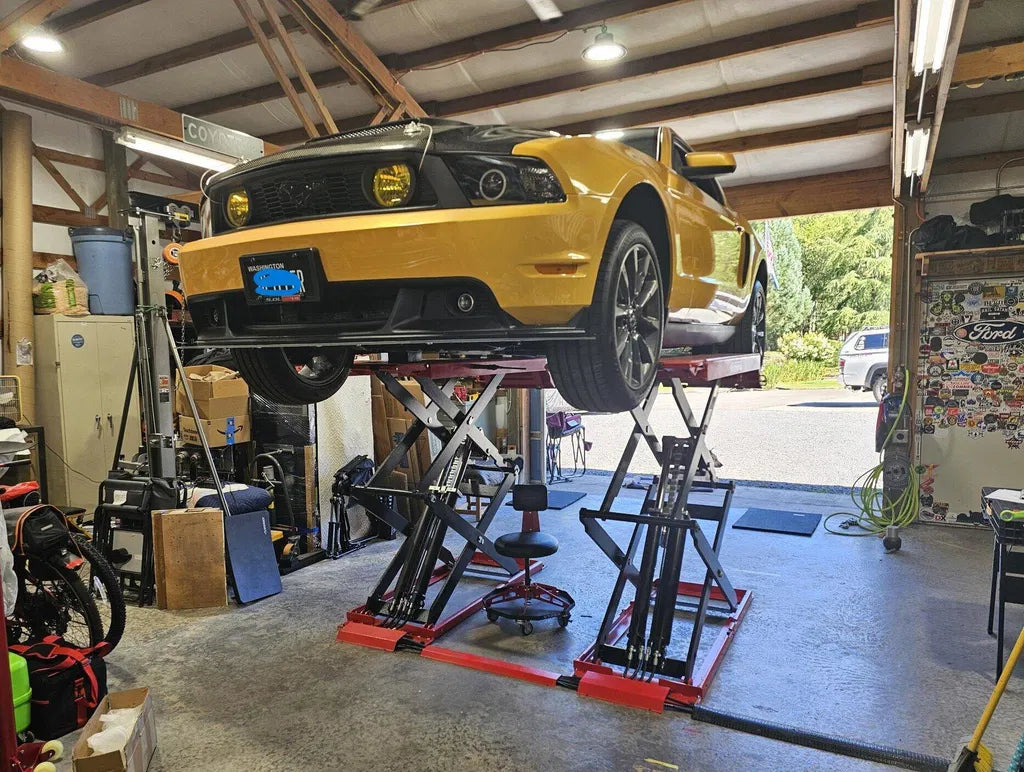
Garages follow the same pattern. A lift looks like a luxury until you have worked with one. After that, the creeper and the jack stands start to look like the hand crank. We collected the everyday differences in 12 Reasons a Car Lift Makes Garage Life Easier.
Further reading: the Mercedes-Benz heritage archive for Karl and Bertha Benz, the U.S. Patent and Trademark Office for Mary Anderson’s 1903 patent, the Indianapolis Motor Speedway Museum for the Marmon Wasp, and the Smithsonian Institution and the Society of Automotive Engineers for the equipment firsts.
More from Olympic Equipment: shop auto lifts and shop equipment at olympic-equipment.com, watch our videos on YouTube, and follow us on Facebook.
Company disclosure: Olympic Equipment sells automotive lifts and shop equipment and has a commercial interest in equipment purchases. This article was prepared with AI assistance.