By Olympic Equipment
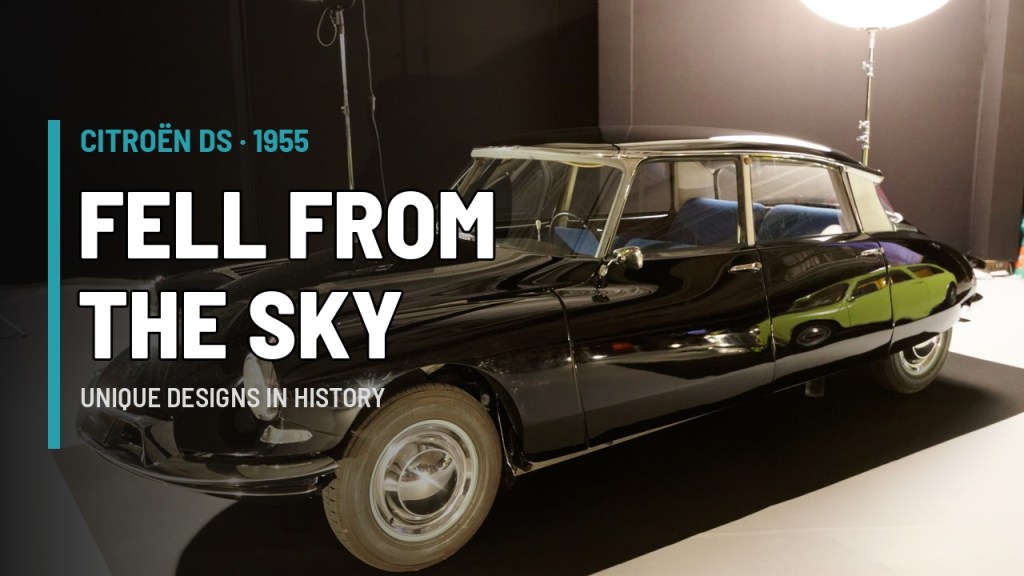
When Citroën revealed the DS at the Paris motor show in October 1955, buyers did not wait: 12,000 orders were taken on the first day. Our new short film looks at the people who created it, the hydraulics underneath it, and why it still looks modern seven decades later.
A name with a double meaning
Say the letters D and S aloud in French and they sound like déesse, the French word for goddess.
Three very different minds
The shape came from Flaminio Bertoni, an Italian sculptor and stylist. André Lefèbvre, an engineer who had trained in aviation, concentrated on airflow and weight. Paul Magès, a self-taught engineer, developed the hydraulic system that the whole car depended on.
Hydraulics at the heart of the car
Magès’ high-pressure system fed a self-leveling hydropneumatic suspension, and the same hydraulics powered the steering, the brakes and the clutch. Where most cars of the 1950s relied on steel springs, the DS was suspended on gas and fluid.
Details that set it apart
The styling matched the engineering: a low, sloping nose, a roof that appears to float above the body and, inside, a steering wheel with a single spoke.
“Fallen from the sky”
In his 1957 book Mythologies, the French writer Roland Barthes described the new Citroën as looking as if it had fallen from the sky.
Twenty years in production
The DS was no short-lived showpiece. It stayed in production until 1975. In 1962, President Charles de Gaulle was riding in one when gunmen opened fire on his car at Petit-Clamart, outside Paris, and he survived the attack. The last DS left Citroën’s Javel factory in Paris on April 24, 1975, bringing the total to 1,456,115 cars.
Sources
- Stellantis Media: DS is 60 and The DS, a 70-year history
- BBC Culture: A goddess of a car
- Paul Magès archives
- Motor1: Citroën DS history
- INA: La Citroën DS
- Complete Car: Citroën DS history
- Supercars.net: 1955 Citroën DS 19
- Roland Barthes, “La nouvelle Citroën,” in Mythologies (1957)
Photo credits
Car photos in the video come from Wikimedia Commons and are used under the licenses linked below. Some are cropped or slowly panned; no endorsement by the photographers is implied. The black-and-white photo of a DS being set up for display shows the 1958 Amsterdam RAI show, not the 1955 Paris launch.
- Citroën DS 19 1968 – Mondial de l'Automobile de Paris 2016 – 001.jpg by Thesupermat, CC BY-SA 4.0
- Mondial de l'Automobile 2012, Paris – France (8665424677).jpg by Mic from Reading – Berkshire, United Kingdom, CC BY 2.0
- Citroën DS 19 – Moteur ! @ Mondial auto 2016 (2-2).jpg by Ahrgrr, CC BY-SA 4.0
- Citroën DS 19 1964 – Mondial de l'Automobile de Paris 2016 – 002.jpg by Thesupermat, CC BY-SA 4.0
- 1967 Citroen DS 19 Pallas.jpg by Calreyn88, CC BY 4.0
- 1971 Citroën DS 21 sedan (19801329141).jpg by Jeremy from Sydney, Australia, CC BY 2.0
- Citroën DS Lenkrad und Armaturenbrett (2012-08-19 Sp).JPG by Lothar Spurzem, CC BY-SA 2.0 de
- Opbouw van de autotentoonstelling in de RAI Citroen DS19, Bestanddeelnr 909-3285.jpg by Harry Pot / Anefo, CC0
- 1957 Citroën DS (15754838255).jpg by Niels de Wit from Lunteren, The Netherlands, CC BY 2.0
- Citroën DS 19 1964 – Mondial de l'Automobile de Paris 2016 – 001.jpg by Thesupermat, CC BY-SA 4.0
AI disclosure: The narration and background music in this video were generated with AI (ElevenLabs). Shots marked “Illustrative scene · AI-generated” on screen are atmosphere scenes made with Runway and OpenArt; they are illustrations and do not depict real vehicles. Every real car shown is a photograph from Wikimedia Commons, credited below. This article was prepared with AI assistance, and every fact in it was checked against at least two independent sources.
Find more classic car and auto history coverage at https://motorcarmagazine.com.