By Olympic Equipment
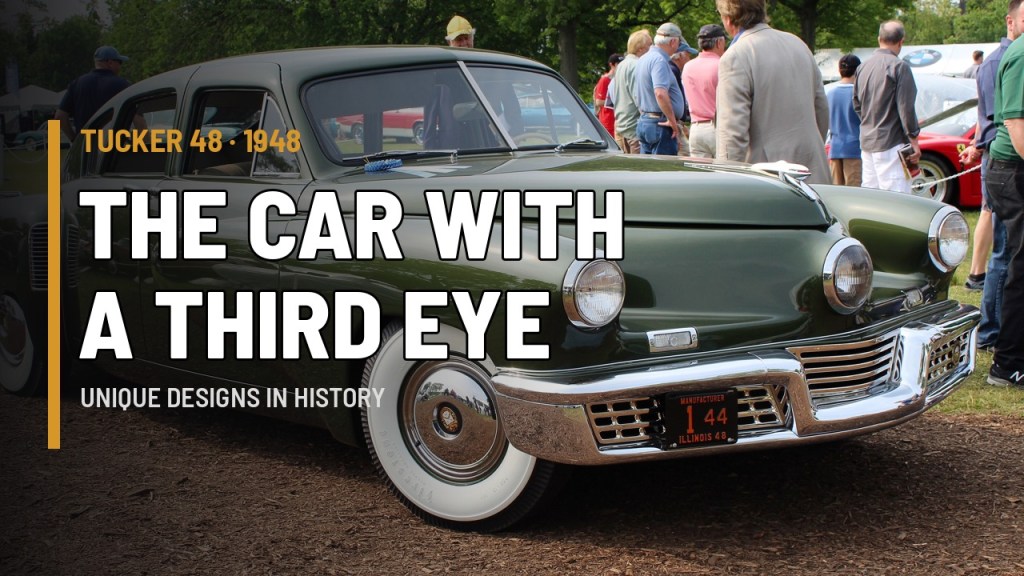
Only 51 Tucker 48s were ever completed before the company that built them failed, yet the car remains one of the best-known American designs of the years after World War II. Our new short film looks at what made it so different: a headlight that steered, a cabin designed with crashes in mind, and an engine in the tail.
Preston Tucker’s car of tomorrow
Preston Tucker promoted his sedan as the car of tomorrow. Its body was styled by Alex Tremulis, who drew a long, low fastback shape at a time when most new American sedans still looked tall and upright.
The Cyclops eye
The detail people remember sits in the middle of the nose. Enthusiasts call it the Cyclops eye: a third headlight that switched on once the steering was turned past roughly 10 degrees and then pivoted with the front wheels, putting light into a bend instead of straight ahead.
Designed around the occupants
Tucker made safety part of the pitch when few carmakers did. The dashboard was padded, and the windshield was designed to pop out in a collision rather than injure the people inside.
Rear engine, hand assembly
The mechanical layout was just as unusual. A horizontally opposed six-cylinder engine rated at 166 horsepower sat at the back of the car, and the cars were put together largely by hand at the company’s plant in Chicago.
Investigation and acquittal
The company never got the chance to prove itself. Federal securities regulators investigated it, and Preston Tucker and his executives were tried on fraud charges. A jury acquitted them on January 22, 1950, but by then the business had already collapsed.
51 cars, 47 survivors
The total of 51 includes the hand-built prototype known as the Tin Goose. Forty-seven of the cars are known to survive, and they still draw a crowd at museums and shows. In 1988 the story reached movie theaters in a feature film directed by Francis Ford Coppola.
Sources
- AACA Museum: Tucker Automobiles exhibit
- Tucker Automobile Club of America: Tucker history
- Audrain Automobile Museum: 1948 Tucker Model 48
- Swigart Museum: Tucker
- Smithsonian National Museum of American History: Preston Tucker’s sedan
- Industrial Design History: Alex Tremulis
- Hagerty: Tucker: the man, the machine, the dream
- Hemmings: Cars of futures past, 1948 Tucker 48
Photo credits
Car photos in the video come from Wikimedia Commons and are used under the licenses linked below. Some are cropped or slowly panned; no endorsement by the photographers is implied.
- 1948 Tucker Sedan at the Blackhawk Museum.jpg by User Seano1 on en.wikipedia, CC BY-SA 3.0
- Tucker Torpedo Brochure c. 1947.jpg by Alden Jewell, Public domain
- 1948 Tucker Model 48 Torpedo.jpg by James Emery from Douglasville, United States, CC BY 2.0
- Stahls Automotive Collection December 2021 147 (1948 Tucker Sedan).jpg by Michael Barera, CC BY-SA 4.0
- Inside a Tucker (2708105811).jpg by Rennett Stowe from USA, CC BY 2.0
- 1948 Tucker Torpedo (no. 44) in Green, engine.jpg by Mr.choppers, CC BY-SA 4.0
- Twin Tuckers.JPG by Trixie99belden, CC BY-SA 3.0
- Cammack Collection of Tucker automobiles (5274537232).jpg by Cathy T from Washington, DC area, CC BY 2.0
- 1948 Tucker Torpedo front, concours 6.1.19.jpg by Kevauto, CC BY-SA 4.0
- 1948 Tucker Torpedo – Flickr – exfordy.jpg by Brian Snelson from Hockley, Essex, England, CC BY 2.0
AI disclosure: The narration and background music in this video were generated with AI (ElevenLabs). Shots marked “Illustrative scene · AI-generated” on screen are atmosphere scenes made with Runway and OpenArt; they are illustrations and do not depict real vehicles. Every real car shown is a photograph from Wikimedia Commons, credited below. This article was prepared with AI assistance, and every fact in it was checked against at least two independent sources.
Find more classic car and auto history coverage at https://motorcarmagazine.com.