Published by Olympic Equipment
Ford expected to sell about 100,000 Mustangs in the first year. Dealers took roughly 22,000 orders on the first day. Few cars have ever been wanted that badly, and very few have stayed in production ever since.
A new kind of buyer
By the early 1960s the first of the postwar baby boom was reaching driving age. Lee Iacocca, then running the Ford Division, believed those buyers wanted something that looked sporty, seated four and did not cost much. Ford’s existing compact, the Falcon, was sensible and sold well, but nobody dreamed about one.
The answer was to keep the Falcon’s proven mechanical parts and wrap them in a new body with a long hood and a short rear deck. Using existing parts kept development costs down and let Ford set a low price.
The launch
The Mustang was shown to the public at the New York World’s Fair on April 17, 1964. The base price was $2,368. Ford bought time on all three television networks the night before, and both Time and Newsweek ran cover stories that week.
Showrooms were mobbed. Because the car arrived in the middle of a model year, enthusiasts still call the earliest examples “1964½” Mustangs, although Ford titled them all as 1965 models.
Build it your way
A large part of the appeal was the order form. The standard engine was an economical six-cylinder. A buyer could add a V8, a four-speed manual transmission, a center console, different wheels and a long list of trim choices. One car could be a daily commuter and another a weekend performance car, and both left the same factory.
Ford sold more than 400,000 Mustangs in the first twelve months. The millionth was built in early 1966, less than two years after the launch.
The cars that followed
The Mustang gave a whole class its name: the pony car. Plymouth’s Barracuda actually reached showrooms about two weeks earlier, but it was the Mustang that set the pattern. Chevrolet’s Camaro and Pontiac’s Firebird followed for 1967, and the rivalry is still part of American car culture.
Why so many are still on the road
First-generation Mustangs are among the most restored cars in the country. Parts are easy to find, the mechanical layout is simple, and there is a club in almost every region.
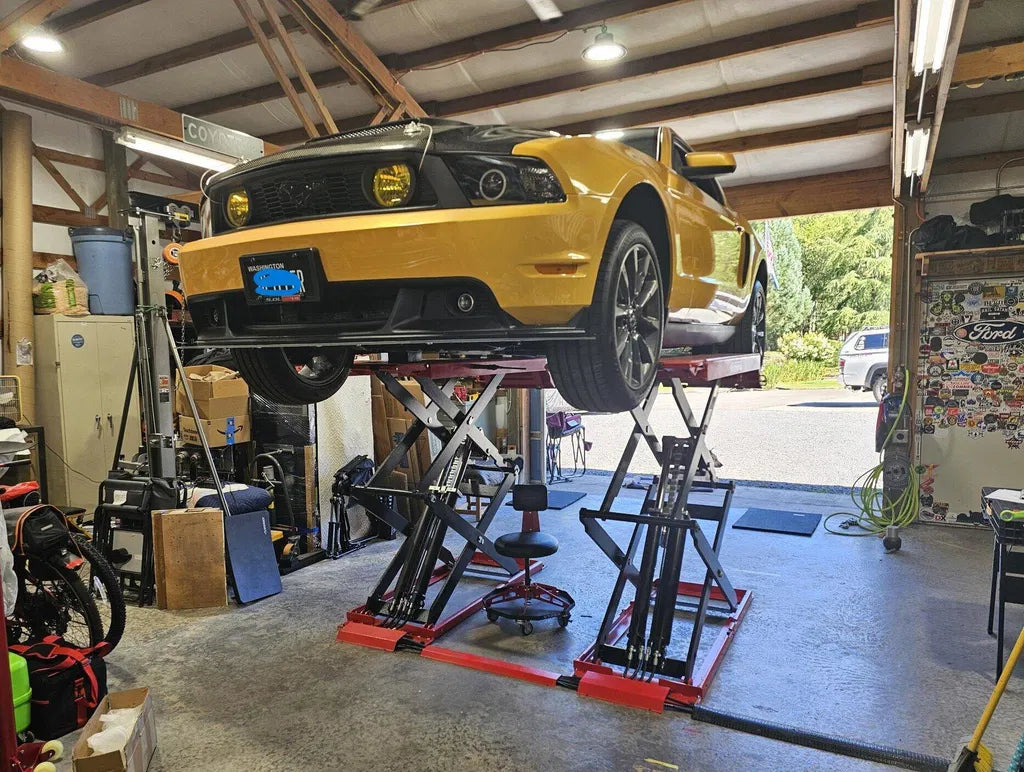
They are also old enough that the underside tells the real story. Floor pans, frame rails, torque boxes and the cowl area are where rust hides, and they are hard to judge from above. If you are shopping for one, read What Can an Undercarriage Inspection Reveal Before Buying a Classic Car? first. If you already own one, Which Lift Design Gives You Better Access for a Restoration Project? covers the choices for working on it, and How to Do a Seasonal Underbody Check on a Lift gives you a routine for keeping an eye on it.
Further reading: Ford Motor Company’s heritage archive, and The Henry Ford museum, which holds the first production Mustang.
More from Olympic Equipment: shop auto lifts and shop equipment at olympic-equipment.com, watch our videos on YouTube, and follow us on Facebook.
Company disclosure: Olympic Equipment sells automotive lifts and shop equipment and has a commercial interest in equipment purchases. This article was prepared with AI assistance.